Are we all Luddites? Why every generation fears the future
At a recent university ceremony in the United States, a senior figure from the tech world, Eric Schmidt (ex-CEO Google), stood on stage and was met with boos. Not disagreement. Not questions. Just very loud boos.
I was shocked. It would be easy to dismiss this as a one-off moment of student protest. But it isn’t. Across universities and public forums, conversations about artificial intelligence are increasingly charged with suspicion, frustration, and in some cases, outright hostility.
I shouldn’t be surprised. In many ways, it mirrors my own finding of how scared 10-year olds are of a future AI-world.
Surveys of young adults show a similar pattern. In the UK, Gallup research found one third of Gen Z feeling real anger against the technology. Anger. There’s a growing sense that AI is not just a tool, but a threat. A disruption. Something happening to them rather than with them. This reaction isn’t just emotional noise. It reflects genuine uncertainty about where people fit in a labour market that is changing faster than the systems designed to support it.
And yet, if you step back far enough, something strange becomes clear. We have been here before.
Every generation believes it is standing at a turning point in history. That something has just changed and that this time, this time, it’s very different.
Apparently, there is a name for it - Chronological Snobbery – and this psychological tendency shows up again and again in human history. The belief that the present moment is uniquely transformative and, generally, uniquely threatening.
There’s another connected human ‘flaw’ – Amara’s Law. Coined by Roy Amara, it describes how we tend to overestimate the impact of a technology in the short term, while underestimating it in the long term.
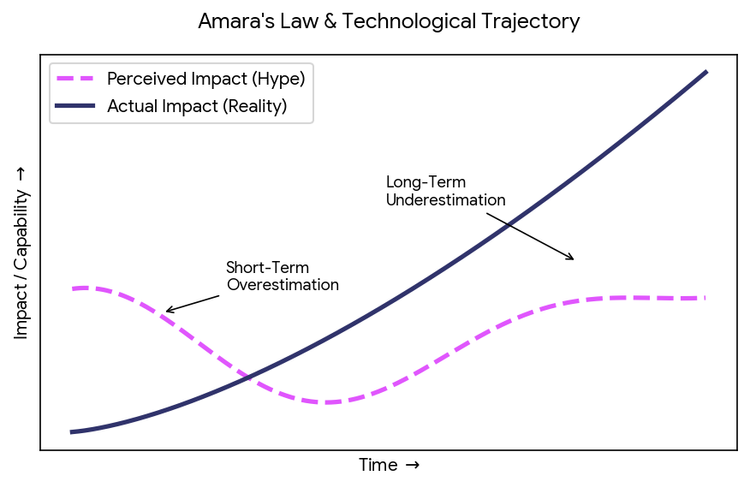
Right now, that technology is, not surprisingly, Artificial Intelligence.
The Luddites
One of the more famous examples of this friction was during the Industrial Revolution.
The rise of machines in textile production led to widespread anxiety among skilled English weavers. In response, groups known as the Luddites destroyed machinery in protest, fearing that mechanisation would remove their livelihoods.
The reaction was not irrational in context. Jobs were genuinely under threat. Entire ways of working were being restructured.
But the long-term pattern is important: productivity increased, new industries emerged, and employment shifted rather than disappeared.
The fear was real, but the outcome was transformation, not collapse.
The Printing Press
When the printing press was introduced, it did not simply spread knowledge - it disrupted control over knowledge.
For the first time, information could be reproduced at scale. This led to massive social, religious, and political change, but also concern: too much information, too quickly, in too many hands.
That same anxiety - about misinformation, overload, and loss of authority - is often directed at AI today.
The Agricultural Revolution
Before machines replaced labour in factories, agriculture was transformed.
Mechanisation reduced the need for manual farming labour, allowing populations to grow and economies to shift. Again, the short-term experience was disruption. The long-term outcome was structural change in society.
This pattern repeats across history:
Labour is displaced
New systems emerge
Society adapts
What once felt alarming becomes normal
The same arc plays out in almost every major technological shift.
Even Socrates worried about writing!
If we go even further back, we find the same pattern again.
Socrates reportedly criticised the invention of writing. He believed it would weaken memory and reduce true understanding - that people would rely on written words rather than developing deep internal knowledge.
It is a striking argument, especially because we only know this view through written accounts by one of his students, Plato, who didn’t follow his opinion on the matter.
Even the earliest ‘information technology’ was met with suspicion.
Why AI feels different (and why that feeling matters)
It would be careless to suggest that all technological change is identical.
AI does feel different in important ways.
Unlike previous industrial shifts, AI does not affect physical labour. It affects cognition itself - writing, analysis, creativity, decision-making. It lowers the barrier to producing work that once required training, experience, or expertise. A McKinsey Global Institute report estimates that up to 30% of hours worked globally could be automated by 2030 due to AI and related technologies.
AI also creates a deeper emotional response because it touches identity, not just employment.
For many people, the fear is not only: ‘Will I lose my job?’, but also: ‘What is my value if a machine can do this too?’.
That is a fundamentally human concern.
The uncomfortable truth: some disruption is painful in the short term
It would also be misleading of me to suggest that this cycle of change is painless.
Even if history shows that technological revolutions eventually create new industries and new forms of work, that does not mean the transition is smooth or evenly distributed.
For many people currently at university or entering the job market, AI does not feel like a distant historical pattern. It feels immediate. Concrete. Personal.
Entry-level roles - often the traditional first step into careers - are already being reshaped. Tasks that once provided training, repetition, and progression are increasingly automated or accelerated. That matters, because it changes not just what work exists, but how people learn to become employable in the first place.
This is where the anxiety becomes understandable rather than irrational. Because while the long-term story of technological change is often one of adaptation and new opportunity, the short-term story can include displacement, uncertainty, and a real sense of reduced security.
And it is not enough to simply say ‘this has happened before’ without acknowledging that, for the individuals experiencing it, this is their only reality.
The real pattern: Acceleration, not apocalypse
So, while the emotional response to AI feels new, the underlying pattern is familiar.
What is changing though is the speed of change.
While the Industrial Revolution lasted roughly 100 years, the digital revolution compressed that timeline into a single decade.
The internet compressed communication. Mobile technology compressed access. AI compresses cognition.
Each wave builds on the last, and each arrives faster than the one before it.
And that acceleration leads to a powerful illusion: that we are approaching some final, irreversible threshold.
But history suggests something else entirely. We are not approaching an endpoint. We are moving through stages - but the transition between those stages is becoming harder to ignore and, certainly, harder to navigate.
The next revolutions are already being imagined
If we zoom out further, it becomes clear that AI is unlikely to be the final major transformation.
We can already see the outlines of what might come next:
Energy breakthroughs such as fusion, where the power of the stars are replicated and controlled on earth.
Molecular or biological computing, where DNA, RNA and proteins store and process data.
Human–machine integration and augmentation.
Each of these will likely trigger the same cycle of excitement, fear, resistance, and eventual adaptation.
Because this is what humans do.
We imagine the future, fear it, resist it. Then, live in it. Adapt to it.
So are we all just modern-day Luddites?
Not quite.
The original Luddites were not simply anti-technology. They were reacting to rapid economic disruption and lack of protection. Their resistance reflected real social pressure, not ignorance.
That distinction matters.
Criticism of new technology is not only normal. It is necessary. It forces societies to think about ethics, fairness, control, and impact.
The danger is not questioning technology. The danger is assuming that questioning it means we can stop it.
Final thought: Learning to live in the pattern
So the question is not whether artificial intelligence will change society. It already is.
The real question is what we believe this change represents.
Because every major technological shift has felt, to the people living through it, like a rupture in reality - a point where the old rules stop working and something unfamiliar takes its place.
But history is quieter than that narrative suggests. Change does not arrive as collapse. It arrives as adjustment. As resistance, then adaptation. As fear, then normality.
The Luddites did not destroy textile frames because they were foolish. Socrates did not worry about writing because he misunderstood intellectual progress. Each reaction made sense in its time, because every generation judges the future using the logic of the present.
And that is the real trap.
Not technology itself, but our stubborn, recurring belief that we are uniquely positioned at the edge of something unprecedented. We are not.
We are part of a long sequence of disruptions that always feel final until they become familiar and the only genuine variable separating use from the mills of the 19th century, or the print shops of the 15th century, is the sheer velocity of the transition.
Ultimately, our choice is not a binary decision between fighting a losing, Luddite battle against progress, or blindly surrendering to it. The real choice lies in our perspective. Our attitude. We can react to the transition as if it is the closing of a book … or we can learn to see it for what it has always been.
Not the end of the story. Just the next chapter.
In a future blog, I want to explore this further - not just the history of technological change, but its present-day impact on the job market, particularly for younger people. I’ll look at what is actually happening to entry-level opportunities, and how students today can begin to position themselves in a world where AI is rapidly reshaping the first steps of a career. [I looked at how we can help our young children in a previous blog].
Recognising the patterns is only the first step - the more important question is how we respond, utilise and adapt to them.